Second Life Basics · · 5 min read
What Is Second Life? A 2026 Guide for New Residents
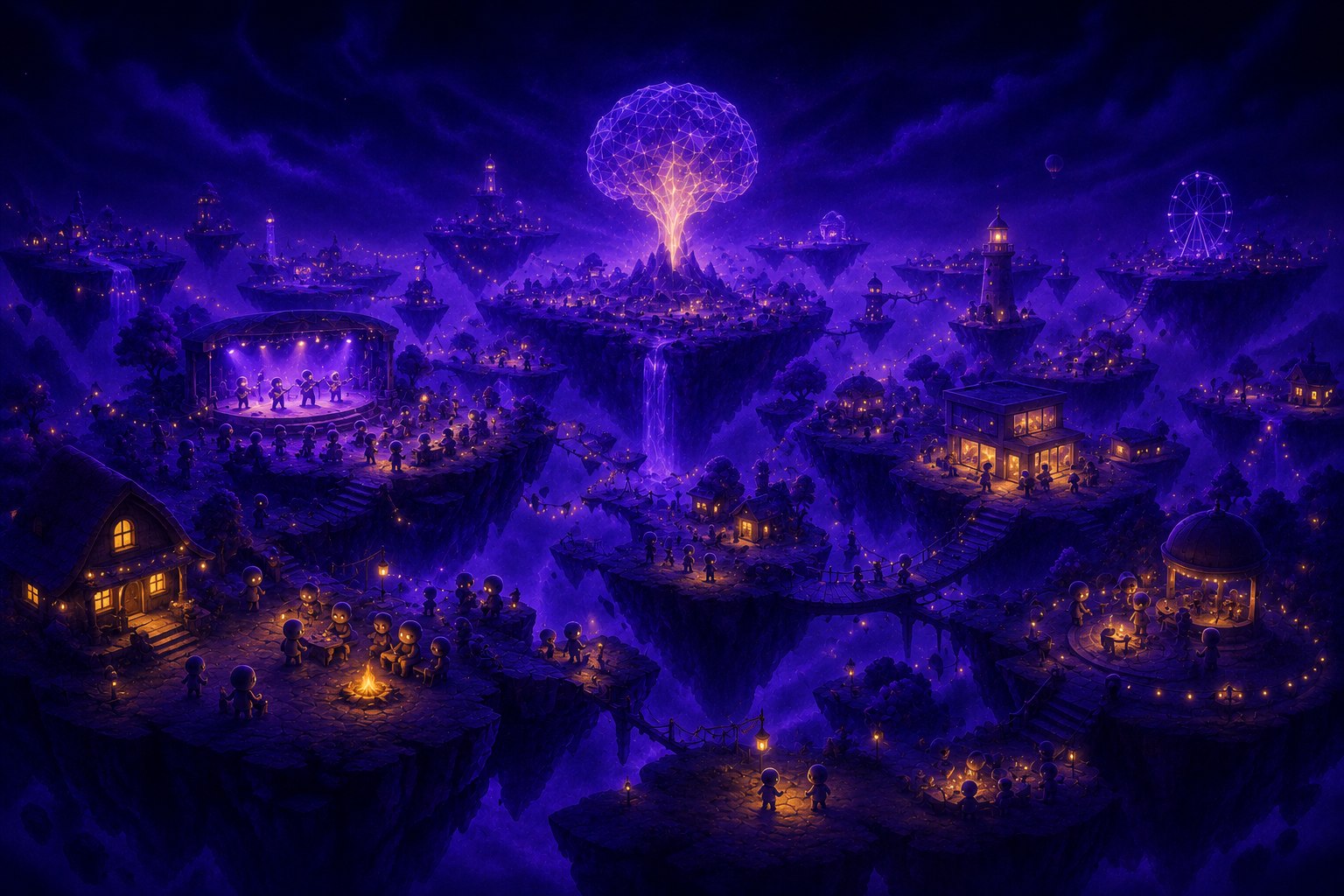
Second Life is a virtual world where residents create almost everything themselves: the clothes, the buildings, the vehicles, the venues, the events and the businesses that sell them. It launched in June 2003, it is still running in 2026, and it holds tens of thousands of people in-world at any given moment. If you are arriving from a headline about the metaverse, or wondering whether the thing you heard about years ago still exists, here is a current and honest picture.
Second Life in one paragraph
It is not a game. There is no score, no levels, and nothing to win. Second Life is a persistent 3D world you log into, where the land is divided into regions owned by residents and organizations, and where the content is made by the people who live there. You can shop, build, dance, host events, run a store, attend a class, roleplay a character, or sit by a virtual ocean and talk to people from six countries. What you do with it is genuinely up to you, which is both its greatest strength and the reason it confuses newcomers.
Is it still active in 2026?
Yes, and with numbers rather than nostalgia behind that answer. Public tracking through mid-2026 shows daily concurrency, the count of avatars in-world simultaneously, ranging roughly between 26,000 and 44,000, with a June 2026 peak of 44,931. The main grid reached 27,239 regions in July 2026, a new high for the year, having net-added more than 330 regions since January. Land in Second Life is a recurring cost paid by real people, so a growing grid is about the most honest activity signal a virtual world can produce.
The community also still turns out in force. SL23B, the 23rd birthday celebration in June and July 2026, ran across 73 regions with 550 exhibitors and a shopping festival featuring 480 creators. We looked at the fuller picture in Is Second Life Still Active in 2026?.
The economy is the point
The single most misunderstood thing about Second Life is that its economy is real.
The in-world currency, the Linden Dollar (L$), can be bought and sold for real money on Linden Lab's currency exchange. That connection is what turns creativity into livelihood: people design and sell clothing, mesh bodies, furniture, animations, buildings, scripts and services, and some do it as their actual job. Land is rented and sold. Venues pay DJs and hosts. Stores hire staff.
This is why so much of the tooling in Second Life, including ours, exists around presence and customer service. When a store is a business, someone not being there when a customer arrives is a lost sale.
What people actually do in-world
- Shopping and fashion. The largest activity by volume, with an enormous creator economy behind it.
- Building and creating. Everything from prims and mesh to scripting in LSL, Second Life's own language.
- Clubs, live music and events. Live musicians perform to real audiences; DJs run venues on schedules.
- Roleplay. Long-running communities with continuity and history, from sci-fi to historical to fantasy.
- Communities and support groups. Second Life has long been a home for people whose circumstances make physical-world gathering difficult.
- Education and business. Universities, training programs and organizations run in-world spaces.
How to join in 2026
The barrier is lower than it has ever been.
- Create a free account at secondlife.com and choose a starter avatar. It costs nothing.
- Pick how you get in. Three options now:
- A desktop viewer, which renders the full 3D world. Firestorm is the most popular; the official viewer is the simplest. See our complete viewers guide.
- The official mobile app for iOS and Android, which renders the world on a phone and is improving steadily through its beta.
- A browser client such as ours, which carries chat, voice, teleports and presence with nothing to install, on any device. See Second Life in your browser.
- Spend an hour in a welcome area. Ask questions. Residents are, as a rule, remarkably patient with newcomers.
- Find your thing. Search a topic you care about and teleport to a region about it. Second Life makes far more sense once you are somewhere specific.
Words you will meet immediately
- Resident: a Second Life user. That is you.
- In-world: logged in and present.
- Region (or sim): one 256m by 256m piece of land on the grid.
- Rez: to make an object appear in-world.
- SLURL: a link to a location, which teleports you there.
- L$: Linden Dollars, the in-world currency.
- TPV: third-party viewer, any client not made by Linden Lab.
- Scripted Agent: an automated account, which must be flagged as such.
- AFK: away from keyboard, common enough that staying online deliberately is its own topic.
Honest expectations
There is a learning curve. The interface is deep because the world is deep. Your first hour may feel like sitting in an aircraft cockpit. It gets much better quickly.
Your first look is not your final look. Nearly everyone upgrades their avatar early; that is a normal rite of passage, not a failure.
It is what you make of it. With no quests or objectives, some people bounce off the openness. The ones who stay usually found a community, a craft or a business within the first month.
Recent platform news, briefly. 2026 saw voice move grid-wide onto modern WebRTC, the mobile app mature considerably, and Linden Lab's browser-streaming experiment end in April. The direction is clear: fewer barriers to getting in.
FAQ
Is Second Life free?
Yes, joining and playing are free. You can spend real money on Linden Dollars, land or premium membership if you choose, but plenty of residents never do.
Is Second Life still popular in 2026?
It holds roughly 26,000 to 44,000 avatars in-world simultaneously through 2026, with a June peak of 44,931, and the grid grew past 27,000 regions in July 2026. It is smaller than the 2007 hype suggested it would be, and considerably more durable.
Is Second Life a game?
No. It has no objectives, score or win condition. It is a social virtual world with a user-made economy, closer to a place than a game.
What do I need to run Second Life?
A desktop viewer wants a reasonably modern computer with a decent graphics card. The official mobile app runs on current phones. Browser clients need only a browser, which is why they work on Chromebooks and work laptops.
Is Second Life safe?
It has adult areas, clearly rated and age-gated, alongside general-rated regions. Use ordinary internet caution, never share your password, and only use viewers listed in Linden Lab's Third-Party Viewer Directory.
Can I make money in Second Life?
Some residents do, through creating and selling content, running venues, providing services or dealing in land. It is a real economy with real competition, so treat it like a business rather than a guaranteed income.